
EditorsAbout the SiteComes vs. MicrosoftUsing This Web SiteSite ArchivesCredibility IndexOOXMLOpenDocumentPatentsNovellNews DigestSite NewsRSS
Boycott Novell

02.25.08

The GPLv3 Not Strict Enough (Should Be Stricter), According to Samba

Posted in Microsoft, DRM, Finance, GNU/Linux, Samba, GPL, FOSS, Kernel at 4:20 am by Roy Schestowitz

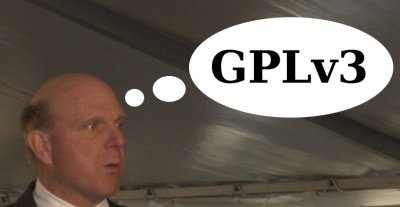
Steve Ballmer scared of GPLv3

While Microsoft and its various proxies, including secretly-hired academics and lobbying arms (CompTIA, ACT, etc.), are on an aggressive crusade against GPLv3, the very same arguments which they try to use as a weapon against GPLv3 are actually a desirable trait. But it does not quite stop there. The GPLv3 is being characterised by Microsoft too strict, but then again Microsoft has always hated (read: feared) the GNU GPL, so it’s bound to find any excuse that suits it.

According to the father of Samba, the GPLv3 hasn’t a weakness which is being too strict. Quite the contrary in fact. Andrew “Tridge” Tridgell wants the GPL to become more restrictive and go harder against DRM — a sentiment that surely Linus Torvalds can subscribe to. In fact, a couple of weeks ago in Australia, Torvalds expressed on numerous occasions his disdain of DRM.

From the new article:

“Some people complain a lot about the anti-DRM provisions, and I would have liked to see those actually be even stronger than they are. Because currently they’ve got some limitations in there that limits some of the anti-DRM provisions of GPLv3 to only being applicable to consumer products. Which means it leaves out, for example, some Samba appliances.

“I’d like to see a future version of the GPL perhaps going a little bit stronger than that and applying it to the non-consumer/enterprise appliances as well” said Tridgell.

We received some mail from Palamida, which is probably one of GPLv3’s best friends in the sense that it ushers its increasing adoption and hands over an invaluable advocacy tool. Someone from the company asked us to address a particular topic:

“Sometime it’d be great to hear your recipe for open source coupled with capitalism, or whether you feel there IS a place for open source in a profit making business (because we’re finding that open source code makes up 50% of code in ALL apps).”

It’s probably important to distinguish between Open Source (in the OSI sense) and Free software (in the GPL sense). To address this question, if in capitalism your capita is physical (i.e. not something intangible like knowledge), then things are simple. They used to be simple.

“Consider Tim Berners-Lee’s motives for creating an open pool of information and ask yourself whether money is ever made on the Web.”Then, as we advanced, the man-made ambition was to (re)define ownership of information, of folklore, rather than to commoditise it. Open Source is a more reciprocal process that revolves around the assumption that information can be exchanged easily and bring benefit to everybody.

Consider Tim Berners-Lee’s motives for creating an open pool of information and ask yourself whether money is ever made on the Web. The problem may emerge when people refuse to give back, to make returns (patches, money, advice). And that’s completely separate from the issues of censorship and net neutrality (tiering and classes).

The transition in transportation means that physical containments of information (such as shrink-wrapped software) are no longer needed. This makes it an unnecessary barrier. It is really a philosophical question that hardly fits this Web site, but it seems to related to the issues that we find with software patents. In the case of Microsoft, not only does it insist on maintaining copyrights of code (which is perfectly acceptable), but it wishes to also own methods (never mind the actual implementation) and protocols, i.e. communication at the end points. That’s what last Thursday’s racketeering announcement was all about.

So, the short answer to that question is that open source is not incompatible with capitalism. That is just a Microsoft smear repeated over and over and over again (repetition does not make validity). Seeking to make profits by hindering communication, however, is a sin. The founding fathers of the United States saw the need to share ideas and something so organic simply must not be owned by an individual. If lobbyists that are paid to further promote greed actually achieve something in Congress, it does not mean they are correct. After all, these are man-made laws.

There is no such thing as an “intellectual property”. Let’s call it what it is: “intellectual monopoly”. It’s a fence. Development (so-called innovation) and profit can be sustained and even thrive without intellectual monopolies. No monopoly has ever done any good to progress. Progress is not to be judged only by currencies.

If you liked this post, consider subscribing to the RSS feed or join us now at the IRC channel.

Pages that cross-reference this one

Listed from October 23rd 2007 onwards, pingbacks and trackbacks (external) are omitted

Leave a Comment

What Else is New


  1. Links 01/12/2008: FreeBSD 6.4 Released; City Moves to OpenOffice.org

    Links for the day


  2. IRC: #boycottnovell @ FreeNode: November 30th, 2008

    IRC Log for November 30th, 2008


  3. Antitrust Complaint About Microsoft, a So-called 'Pirate'

    Microsoft is reported to the EC for overcharging, media contains a lot of Microsoft-imposed daemonisation


  4. Boycott Novell Leaps

    3.2 million hits this month


  5. Microsoft's Forecast Suffers Fresh Blow, Online Problems Linger on

    Microsoft pressured by pessimistic analysts, profitability online remains a struggle


  6. On Lipstick, Pigs, and Windows

    Problems for Windows Mobile (ridicule of the idea of a Microsoft phone) and continued demise of Windows Vista


  7. Stuffing It Up, Microsoft Edition

    Microsoft sneaks its way into various consortia, events and press via familiar pressure groups and known 'loyals'


  8. Eye on Microsoft: Another Messy Week for Security

    Summary of large-scale, high-impact security issues in Windows


  9. Microsoft Hijacked Yahoo! from the Inside (Updated)

    Microsoft is stepping up to buy Yahoo!, but history must not be neglected


  10. Mono Critique Goes a Long Way Back

    Quick look back at criticism of Mono


  11. Links 30/11/2008: GNU/Linux Consistency; Netbook Summit Coming

    Links for the day


  12. Mono Tries to Enter KDE

    A person tries to promote Mono in KDE


  13. IRC: #boycottnovell @ FreeNode: November 29th, 2008

    IRC Log for November 29th, 2008


  14. Microsoft Imprisons the Ukraine and a South African University

    More secret deals and more lock-in that's targeted at young people who are given no choice


  15. Is Silverlight About 'Killing' GNU/Linux?

    Breaking a session because of this thing called Silverlight


  16. Patents Roundup: Patent Failure, Rambus Ambush, and Death by Patents

    News about patents with limited focus on software patents


  17. Why Journalism is Junk

    New examples from the press of the sad state of reporting


  18. Do-No-Evil Saturday - Part III: Managed Objects Managed by Novell, Identity Management, and Lots More

    The Managed Objects acquisition is done, Novell's proprietary software products make several appearances in the press


  19. Do-No-Evil Saturday - Part II: SLED at Lenovo and Wyse, SLES, Xandros

    A summary of GNU/Linux-related news from Novell and Xandros


  20. Do-No-Evil Saturday - Part I: Old OpenSUSE EULA Dies, Yastie is Born

    Some of the main developments this week involve stripping of a bad EULA and addition of a mascot to YaST


  21. SCO Death Watch

    A roundup of news about SCO's loss to Novell


  22. Links 29/11/2008: Java+GNU/Linux; KDE4 Screencasts

    Links for the day


  23. IRC: #boycottnovell @ FreeNode: November 28th, 2008

    IRC Log for November 28th, 2008


  24. Respecting AstroTurfers?

    Have Microsoft or Novell personally corresponded with Boycott Novell about their efforts? Here's an answer


  25. New in Boycott Novell: Site FAQ

    A new page addresses FAQs (Frequently-Asked Questions)


  26. More Microsoft Abuses in Italy and Europe

    Microsoft's mischiefs in Italian universities and a few more stories from Europe (Holland & Portugal)


  27. While the World is Asleep, Mono with Microsoft-patented WinForms Slips into Ubuntu 9.04

    Mono boosters push a little more Microsoft "IP" into the next Ubuntu


  28. The OOXML Trap Bites British Parliament

    Another lesson about Microsoft's inability (possibly deliberate) to keep its own office suite compatible


  29. Microsoft 'Extends' Open Source Scope

    Once again, Microsoft seems to be leading to confusion around open source


  30. Novell Linux: Another Platform (as in Kernel) for Windows?

    An analysis of the role of Mono in Novell's GNU/Linux distribution and possible Microsoft motives


An invade, divide, and conquer Grand Plan

Novell CEO Ron HovsepianHighlight: Novell was the first to acknowledge that Microsoft FUD tactics had substance. Novell then used anti-Linux FUD to market itself. Learn more

Xandros founderHighlight: Xandros let Microsoft make patent claims and brag about (paid-for) OOXML support. Learn more

Linspire CEO Kevin CarmonyHighlight: Linspire's CEO not only fell into Microsoft arms, but he also assisted the company's attack on GNU/Linux. Learn more

Hand with moneyHighlight: Microsoft craves pseudo (proprietary) standards and gets its way using proxies and influence which it buys. Learn more

Eric RaymondHighlight: The invasion into the open source world is intended to leave Linux companies neglected, due to financial incentives from Microsoft. Learn more

XenSource CEOAnalysis: Xen, an open source hypervisor, possibly fell victim to Microsoft's aggressive (and stealthy) acquisition-by-proxy strategy. Learn more

More analysis >>

Recent Posts