'"When you speak about interoperability do you mean across different platforms, like Windows and Unix, or among different versions of Windows, like XP and 2000." He meant among different versions of Windows.'
--Joe Wilcox
In Microsoft's latest attack on
LAMP, Adobe and
Ajax, it wants to have these replaced by technology that
excludes Google, GNU/Linux and many other rivals. Even the W3C is at risk.
Watch
this new article and see if you spot an oddity.
Silverlight 1.0 for Windows and Mac shipped last September with the Silverlight 2.0 beta one expected "shortly" according to Guthrie.
[...]
Scott Guthrie, a general manager in Microsoft's developer division, blogged ahead of Adobe's AIR and Flex news that Silverlight 2 would feature a cross-platform version of its .NET Framework and let developers program Silverlight content using any .NET language.
Novell's Moonlight is irrelevant here because it is not Silverlight. It's a case of allowing Microsoft to pass on the illusion that GNU/Linux will have some crumbs (poor catch-up) that can still be considered 'support',
provided that you pay Microsoft some patent tax,
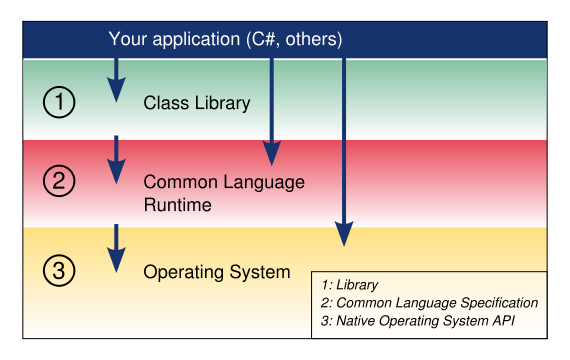
Have a look at Silverlight's framework. It's just part of the Windows/Vista stack, which it is heavily based on.

Image from the public domain
Now, have a look at Mono:
GPL-licensed graphics
Does Mono have Microsoft DRM? Does Mono have WPF? Feature parity at all? No? Well, that's why becoming Microsoft wannabes and blindly adopting the company's technology is a very bad idea. It only helps Microsoft. Novell in the case, with Mono and Moonlight, is serving Microsoft.
This is not the first time that Microsoft redefines terms to suit its own agenda. Examples include "interoperability" (taxoperability), "free software" (gratis), "open source" (look but don't touch), "release candidate" (a semi-cooked Vista build, according to Microsoft Watch) and "cross platform" (running on XBox and different version of Windows).
One must not allow to Microsoft hijack crucial language like this. The company knows very well why it does that. It's like brand name (or trademark) theft. Remember OpenOffice getting renamed OpenOffice.org because of Microsoft (never mind
Lindows becoming Linspire)? Here is an E-mail that we received just hours ago (it's directed at Microsoft):
And you guys think it is cool calling it Office Open and not confusing. Change it already if you respect other peoples property and rights. Don't u have any dignity.
Yet every day you sending out hundreds of C&D when folks use a logo of MS, or any little thing which might infringe and usually not to protect your rights.
http://lifehacker.com/360503/open-office-2007-documents-in-openoffice-with...
We mentioned this only days ago. ECMA (Microsoft) chose to completely ignore this issue, which makes people confuse OpenOffice.org (open source) with a proprietary format (OOXML).
⬆

