
EditorsAbout the SiteComes vs. MicrosoftUsing This Web SiteSite ArchivesCredibility IndexOOXMLOpenDocumentPatentsNovellNews DigestSite NewsRSS
Boycott Novell

03.30.08

Clannish Grouping Makes Tribal Elections (ISO and OOXML)

Posted in Microsoft, Finance, Videos, Asia, Antitrust, Oracle, Open XML at 11:29 pm by Roy Schestowitz

Never trust the Microsoft Trust

It was not so long ago that Larry Ellison described the competition against Microsoft in an alarmist fashion. He back then described the scenario as one which involves “Bill Gates against the world.” You can find a video where he speaks about Microsoft right here.

“It truly becomes concerning when you see a formation of what used to be known as the “Trust”, just before anti-trust laws were introduced.”Increasingly, as we clearly see in the case of OOXML, it’s not just Microsoft which pushes for greater adoption of its poor formats, but also Microsoft partners, which form what Microsoft refers to as its growing ecosystem. It truly becomes concerning when you see a formation of what used to be known as the “Trust”, just before anti-trust laws were introduced. Find out more about it in the following documentary video (requires gnash/Flash).

When the broad market’s needs collide with a status quo comprising Microsoft-dependent industries, with grossly overwhelming presence in panels involving Microsoft’s future, that becomes an issue. It truly become a case of “Microsoft (+parters) versus everybody else”. The consumer is of course likely to suffer the most as a consequence.

Have a quick look at this new writeup which touches on a similar question: It’s summarised as “Free Market vs the OOXML”.

Supporting open standards does not equate to supporting standards for which ISO said are standards. It means supporting technologies which were designed to be fully interoperable, compatible and transparently documented so as to be fitting for use by a large number of people without forming a situation of lock-in to a particular company. An open standard is a technology whose inner workings are completely transparent and whose use does not constitute dependance on any particular product or company, and which is commonly used in the market.

It could be argued that other companies quite likely to benefit from Microsoft Office dominance are simply those which share wealth, notably Microsoft partners. A week ago we saw a summary that explained why India’s “Yes” voters are all indeed just in Microsoft’s pocket. Rather than looking at the merits (or lack thereof) of the document they voted on, the decision seems to have been based solely on personal financial considerations. And that’s not beneficial to anybody, except the clique that Microsoft has grown to selectively circulate wealth. Think of this as a seclusive group of egocentric elites.

Was it any different Malaysia, which had been heavily abused by Microsoft? Apparently not. Just have a look at the latest report:

The final vote for TC4 was: 4 Approvals, 8 Disapprovals and 5 Abstentions.

What is interesting is that the Approvals, like in the case of India are associations which have strong ties with Microsoft, of whom provides support, funding and are sponsors to their events.
Considering the fact that a conflict of interests obviously exists, why are these Microsoft-affiliated participants allow to even vote? What about the disproportionate number of Microsoft partners? This demonstrates just how flawed the process is, and how susceptible it is to gaming and abuse.

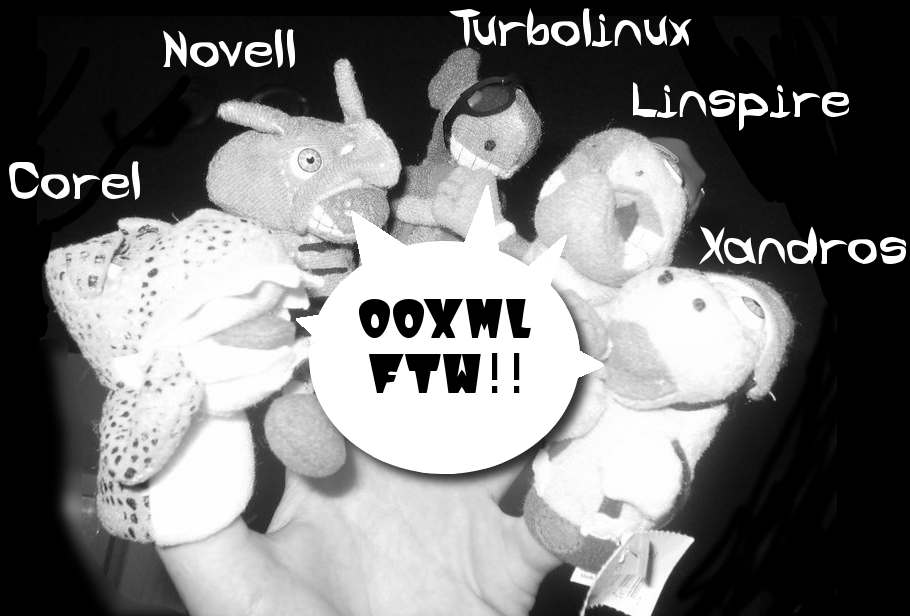
OOXML Suppets
Pay-to-play puppet state

If you liked this post, consider subscribing to the RSS feed or join us now at the IRC channel.

Pages that cross-reference this one

Listed from October 23rd 2007 onwards, pingbacks and trackbacks (external) are omitted

Leave a Comment

An invade, divide, and conquer Grand Plan

Novell CEO Ron HovsepianHighlight: Novell was the first to acknowledge that Microsoft FUD tactics had substance. Novell then used anti-Linux FUD to market itself. Learn more

Xandros founderHighlight: Xandros let Microsoft make patent claims and brag about (paid-for) OOXML support. Learn more

Linspire CEO Kevin CarmonyHighlight: Linspire's CEO not only fell into Microsoft arms, but he also assisted the company's attack on GNU/Linux. Learn more

Hand with moneyHighlight: Microsoft craves pseudo (proprietary) standards and gets its way using proxies and influence which it buys. Learn more

Eric RaymondHighlight: The invasion into the open source world is intended to leave Linux companies neglected, due to financial incentives from Microsoft. Learn more

XenSource CEOAnalysis: Xen, an open source hypervisor, possibly fell victim to Microsoft's aggressive (and stealthy) acquisition-by-proxy strategy. Learn more

More analysis >>

Recent Posts