EditorsAbout the SiteComes vs. MicrosoftUsing This Web SiteSite ArchivesCredibility IndexOOXMLOpenDocumentPatentsNovellNews DigestSite NewsRSS
Boycott Novell

05.14.08

Novell Starts Buying Its Own Stock (Sign of Weakness)

Posted in Microsoft, Finance, Novell at 3:57 am by Roy Schestowitz

If the investors go away, then someone needs to fill the void

Novell has just earned itself a very low position (48th) in the “most influential tech vendors” ladder, which seems very gut feeling-driven. Almost on the very same day came this press release from Novell:

Novell, Inc. (Nasdaq: NOVL) today announced that its Board of Directors has authorized the repurchase of up to $100 million of the Company’s outstanding shares of common stock.

Associated Press (at Forbes) had this to add about the buyback program:

There is no fixed expiration date for the program.

Ron Hovsepian smilesIt was almost a year ago that Ron Hovsepian told Reuters about the possibility of buybacks, or at least responded to a question about it. We wrote about Novell buybacks in [1, 2] and some more related posts include [1, 2, 3, 4, 5].

We also discussed Novell’s massaging of its financial figures, which may be similar to Microsoft’s [1, 2, 3]. Novell expects layoffs, not just off-shoring that Bill Gates promotes. Both companies share a similar dilemma which is tied to legacy. Microsoft is by all means on a similar boat, with buybacks that left it without so much cash in the bank (far less than ever before).

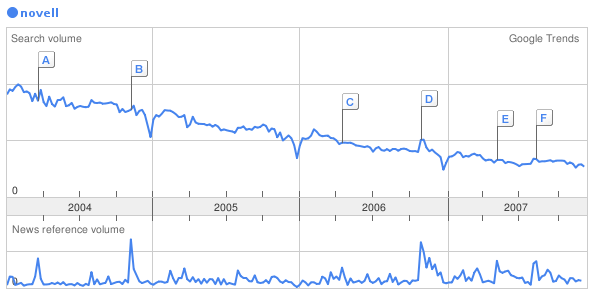
Novell's Google Trends chart
Google Trends: search volume for “Novell”

Pages that cross-reference this one

Listed from October 23rd 2007 onwards, pingbacks and trackbacks (external) are omitted

12 Comments »

  1. Niklas (sic!) Koswinkle said,

    May 14, 2008 at 4:27 am

    If you want to see a sign of weakness, you don’t have to look any further than this blog: It’s hilarious the read to your little, un-enlightened ‘analyses’ of the stock value of Novell. Firstly, it is very obvious that you have no idea what you are talking about. But that’s not the funny bit. The funny bit is that you seem so desperate to see a correlation between a business-decision, that you think of as immoral, and the economic well-being of the actors who made that decision.

    Aren’t you educated enough to understand that the latter hasn’t got anything to do with the former? Are you really expecting a financial backlash due to a politically incorrect decision?

    You don’t know anything about the real word; but we already knew that…

    For the record: Novell is doing much better than Sun which you - in spite of evidence to the contrary - tout as defender of freedom.

    Note: comment has been flagged for arriving from a possible incarnation of a known (eet), pseudonymous, forever-nymshifting, abusive Internet troll that posts from open proxies and relays around the world.

  2. Paulo said,

    May 14, 2008 at 6:45 am

    This post is a total joke. I have been to this site a few times and after reading this post, you clearly have no idea what you are talking about. Before posting any ridiculous comments on share buybacks, perhaps you should sharpen your business skills just a ‘wee’ bit.

  3. ZiggyFish said,

    May 14, 2008 at 11:40 pm

    if you look at novels history, you will see that Novel have been going down hill since the start of the Microsoft - Novel deal

  4. Roy Schestowitz said,

    May 14, 2008 at 11:46 pm

    It would have been the same without Microsoft, I suppose, but the problem is that with Microsoft’s help Novell is hurting IBM, Sun, Red Hat and others for a variety of reasons. Many of those companies promote Free software.

  5. Niklas (sic!) Koswinkle said,

    May 15, 2008 at 3:49 am

    I realize that you didn’t bother to search for anthing else than ‘Novell’.

    Try ‘Sun Java’. Yep, it’s going downwards.

    Now for the funny part: Search ‘Red Hat’. Wow. That’s a sharp decline.

    What does this tell us? Are all values in the world rapidly falling? No, it’s only Google Trends which exaggerates the developments. Google Trends is NOT a serious source of information. Tell me you haven’t even realized that they don’t indicate any units on the y-axis? Yeah, that’s right; you can’t tell whether it indicates cents or millions…

    Note: comment has been flagged for arriving from a possible incarnation of a known (eet), pseudonymous, forever-nymshifting, abusive Internet troll that posts from open proxies and relays around the world.

  6. ZiggyFish said,

    May 15, 2008 at 4:29 am

    Show me the graph from a ’serious source of information’

  7. Niklas (sic!) Koswinkle said,

    May 15, 2008 at 4:35 am

    Perhaps there is none? Is that my mistake? It is no ME who is desperately searching for bad news about Novell.

    One thing is for sure: Google Trends is NO source for reliable info on stocks.

    Note: comment has been flagged for arriving from a possible incarnation of a known (eet), pseudonymous, forever-nymshifting, abusive Internet troll that posts from open proxies and relays around the world.

  8. Shane Coyle said,

    May 15, 2008 at 4:49 am

    Well, here is a comment/quote I had once posted regarding the general idea of stock buybacks - anyone familiar with my articles may recall, I am finance-impaired as well:

    A bit about buybacks for those of us who are finance-impaired (me):

    Buy-backs are intended to give investors increased confidence. The logic goes something like this: if a company buys back its own stock, the share price should go up - first, there are fewer shares outstanding after the buy-back so each share represents a greater portion of the company’s total equity, and second, with fewer shares outstanding the company’s earnings per share and book value per share figures should look more attractive, which might have a positive effect on the stock. A buy-back is also said to counteract the dilutive nature of employee share incentive schemes. But buy-backs do not always result in the share price going up. For one thing, the company has had to spend some of its cash reserves - which really belong to the shareholders anyway. While the buy-back seems to counteract the dilutive effect of employee stock options, all companies are really doing is transferring the problem: the dilutive effect of the employee share incentive schemes is now directly visible on its balance sheet where that huge pot of cash used to be. But just as importantly, by definition buying back stock means that the company feels there is no better way of using that cash reserve than ploughing it into the stock markets to buy its own shares - it does not feel that investing that cash in additional personnel, assets, intellectual property, or even other businesses would be a better use of that money. For some, it could be seen as the last desperate measure of a management team which has run out of inspiration.

    FWIW

  9. ZiggyFish said,

    May 15, 2008 at 5:12 am

    Niklas (sic!) Koswinkle:

    your the one that is ‘desperately searching’ to prove Roy wrong. And you haven’t found any evidence to prove him wrong.

  10. Roy Schestowitz said,

    May 15, 2008 at 5:25 am

    I have a follow-up post on this buyback story coming shortly. By the way, in order to demonstrate Novell success (or lack thereof) as a function of time one can consider # of employees. Guess what? it’s going down. Another criterion could be market cap. Even executives/CEOs shuffle.

  11. Niklas (sic!) Koswinkle said,

    May 15, 2008 at 5:53 am

    Ziggy, it is Roy who has to prove HIS outrageous theories, not me.

    Note: comment has been flagged for arriving from a possible incarnation of a known (eet), pseudonymous, forever-nymshifting, abusive Internet troll that posts from open proxies and relays around the world.

  12. ZiggyFish said,

    May 15, 2008 at 6:00 am

    Niklas (sic!) Koswinkle:

    I would agree with you if you had something back up your position. All I’ve heard from you is either FUD for personal attacks.

Leave a Comment

An invade, divide, and conquer Grand Plan

Novell CEO Ron HovsepianHighlight: Novell was the first to acknowledge that Microsoft FUD tactics had substance. Novell then used anti-Linux FUD to market itself. Learn more

Xandros founderHighlight: Xandros let Microsoft make patent claims and brag about (paid-for) OOXML support. Learn more

Linspire CEO Kevin CarmonyHighlight: Linspire's CEO not only fell into Microsoft arms, but he also assisted the company's attack on GNU/Linux. Learn more

Hand with moneyHighlight: Microsoft craves pseudo (proprietary) standards and gets its way using proxies and influence which it buys. Learn more

Eric RaymondHighlight: The invasion into the open source world is intended to leave Linux companies neglected, due to financial incentives from Microsoft. Learn more

XenSource CEOAnalysis: Xen, an open source hypervisor, possibly fell victim to Microsoft's aggressive (and stealthy) acquisition-by-proxy strategy. Learn more

More analysis >>

Recent Posts