
EditorsAbout the SiteComes vs. MicrosoftUsing This Web SiteSite ArchivesCredibility IndexOOXMLOpenDocumentPatentsNovellNews DigestSite NewsRSS
Boycott Novell

05.26.08

British Library Versus Preservation, Pro Vendor Lock-in (Microsoft OOXML)

Posted in Formats, Microsoft, Europe, America, Open XML, Ecma at 12:37 am by Roy Schestowitz

ooxml_demo_4.jpg

We must assume, naturally, that readers have not yet come across previous coverages of the appalling situation at the British Library. Here are some posts of interest, which put things in context and perspective, as well provide some background:

Digital curation is one of the most important aspects of preservation of national assets and reduction/prevention of digital rot (or “information decay”, which Vint Cerf recently warned about). You can find a long videotaped lecture about the subject right here. For a live demonstration that is backed by news, consider the first part of this recent post. Add to this the following new article that bears the headline “Boyer: Records useless without access.” To quote the concluding portion:

We’ve already seen examples of electronic records essentially being useless to the average resident because they do not have some piece of specialized software the state used to create them. That’s a situation that needs to be fixed.

The report is lengthy, and some sections are too technical for most people (including me) to understand, but the underlying conclusion is that the Legislature needs to pass legislation that ensures openness. To do that, the study recommends lawmakers establish a state electronic records committee that will constantly evaluate, develop and implement policy.

ISO in moneyIn light of all this, consider again what the British Library foolishly does at the moment. Not only has it put its weight behind the colossal scandal commonly referred to as “OOXML”. It is prepared to give Microsoft control over everybody’s invaluable assets, never mind the company’s status as a “multiple-times convicted monopolist”, betrayer of partners (in this case the British Library is at risk), not to mention its not-so-certain future (no company lasts forever, not even with bankruptcy protection).

Here again is a classic from <NO> OOXML where you can see Microsoft lobbyist Jan van den Beld [1, 2, 3, 4, 5, 6, 7] shaking hands with Microsoft’s Jean Paoli. In the background you find Adam Farquhar [1, 2, 3, 4, 5, 6, 7, 8], whose history with Microsoft could make one cringe (see more in the references at the top).

This is an image from the good old days. Microsoft’s Jean Paoli hands over the OOXML specification to Jan van den Beld, the general secretary of ECMA. And you find Adam Farquhar from the British Library, the bearded person on the right. The British Library was instrumental to legitimizing the whole ECMA and ISO OOXML standardisation process as an ‘independent’ participant in the committee work. ECMA did a brilliant job to mature the specification text to get it ISO fast-tracked. Or as the ISO BRM convenor and recent consultant for the British Library Alex Brown reflects:

Ecma made the road very rocky though, by initially producing a text that was so lousy with faults.
At the end of the day you have a company that wants your data and wants you dependent on its existence and survival. It uses the government to establish this lock-in without giving you, the taxpayer, an opportunity to say no. That’s partly why Microsoft is said to have entered the medical areas where Microsoft’s endurance can become a matter of people’s lives.

The short article above proceeds to discussing the fact that Microsoft tossed out its book-scanning project. That happened just a few days ago. Microsoft cited “poor demand” as the reason for discontinuation. In other words, preserving and enabling access to books was never Microsoft’s motive. If there’s no money in it, Microsoft is disinterested. Let the scanning partners be ditched and hopefully find some new direction. Good luck to the British Library, too.

Would you trust Microsoft with your medical data? Would you trust your national library putting its assets in Microsoft’s hands, thanks to the advice of a paid Microsoft lobbyist (Mr. “you are well paid, shut up”)? Bear in mind that the United States Library of Congress too has sold out to Microsoft. This happened quite recently (previously alluded to in [1, 2, 3, 4, 5, 6, 7, 8, 9, 10]), possibly in an even worse way.

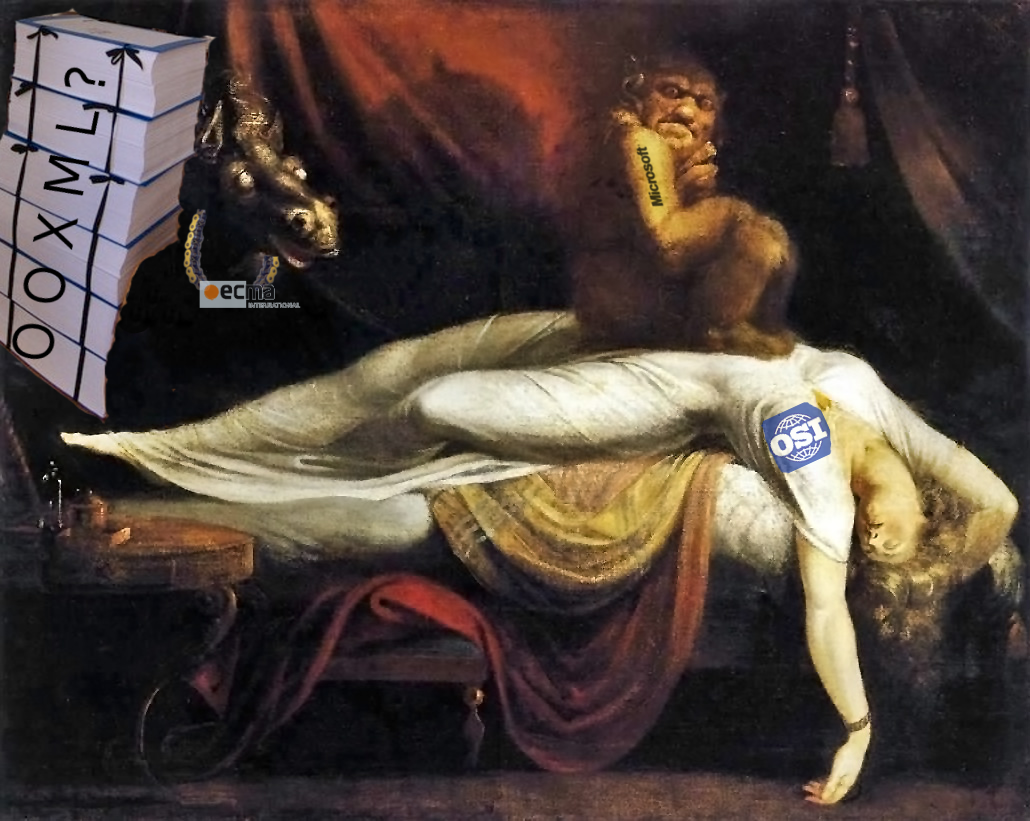
OOXML: the biggest scam Microsoft was able to afford. And it’s only part of a larger proprietary stack.

The Nightmare

If you liked this post, consider subscribing to the RSS feed or join us now at the IRC channel.

Pages that cross-reference this one

Listed from October 23rd 2007 onwards, pingbacks and trackbacks (external) are omitted

Leave a Comment

An invade, divide, and conquer Grand Plan

Novell CEO Ron HovsepianHighlight: Novell was the first to acknowledge that Microsoft FUD tactics had substance. Novell then used anti-Linux FUD to market itself. Learn more

Xandros founderHighlight: Xandros let Microsoft make patent claims and brag about (paid-for) OOXML support. Learn more

Linspire CEO Kevin CarmonyHighlight: Linspire's CEO not only fell into Microsoft arms, but he also assisted the company's attack on GNU/Linux. Learn more

Hand with moneyHighlight: Microsoft craves pseudo (proprietary) standards and gets its way using proxies and influence which it buys. Learn more

Eric RaymondHighlight: The invasion into the open source world is intended to leave Linux companies neglected, due to financial incentives from Microsoft. Learn more

XenSource CEOAnalysis: Xen, an open source hypervisor, possibly fell victim to Microsoft's aggressive (and stealthy) acquisition-by-proxy strategy. Learn more

More analysis >>

Recent Posts